Sunday, January 9, 2011

Romania to Tax Witches


The government of Romania has decided to levy a 16% income tax on witches and the local witches are none too pleased. They’ve thrown poisonous mandrake plants into the Danube to put a curse on the officials, and threatened other spells that use unseemly animal bits.

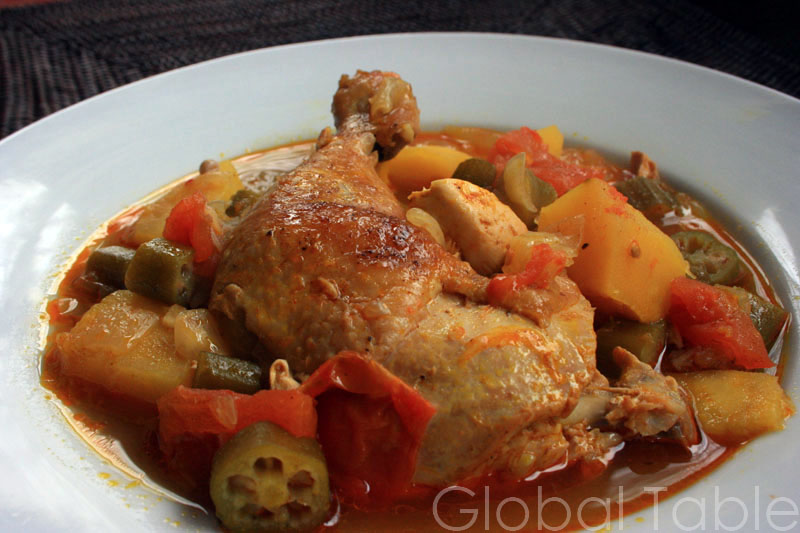
As garlic, rosemary, and thyme are said to repel witches, I’ve posted this recipe for Chicken Ghiveci (Romanian braised chicken) for any Romanian ministers who might be trolling food blogs for salvation.

Even if you’re not a governmental official in Bucharest (and what are the odds?), this roasted chicken is hearty, flavorful, and perfect for a snowy night.

Chicken Ghiveci (Romanian Braised Chicken)

3 T. olive oil
1 medium onion, thinly sliced
5 garlic cloves, minced
2 bell peppers, seeds removed and sliced
2 pounds chicken breasts
1/2 c. tomato paste
1 t. fresh thyme
1 t. fresh rosemary
2 carrots, coarsely chopped
1/2 c. dry white wine
salt and pepper to taste

Heat oil in a large saute pan over medium heat. Add onions and garlic saute until soft and translucent. Add bell pepper and stir fry for one minute more.

Add chicken breasts, browning both sides (about ten minutes). When browned, add the remaining ingredients and saute for one min then cover and cook for 40-45 minutes until liquid runs clear when chicken is pierced with a fork.

Garnish with finely chopped thyme and rosemary and serve over rice.

Notes: Ghiveci is traditionally made with seasonal vegetables. This version adds chicken to give it some weight. Customarily, it’s also prepared with potatoes but they seem a bit much with the rice so I omitted them. If you’re training for the Iditarod, feel free to add in two cups of diced potatoes.

Labels: , , ,

Friday, December 17, 2010

Poulet Bearnaise from Provence


In Provence, Ford Madox Ford’s rapturous ode to the region, the author describes a recipe given to him by a glamorous young woman from London who was reputed to be one of the best chefs in the city. She shares this recipe for Poulet, Bearnaise, chicken roasted over two pounds of garlic. Ford Maddox Ford was born on December 17, 1973. Joyeux Anniversaire et Bon Appetit!

Poulet Bearnaise

1 c. olive oil
1 large roasting chicken, 4 to 5 pounds
Kosher salt and pepper
2 lbs. garlic (24 to 30 bulbs, not cloves)
4 large baking potatoes

Preheat the oven to 325 degrees. Put a large pot of lightly salted water on to boil. On another burner, place a large ovenproof casserole over medium heat with 1/2 cup of olive oil.

Truss the chicken and season it all over with salt and freshly ground black pepper. When the oil is hot, gently slide the chicken, breast-down, into the casserole. Brown the chicken carefully on all sides. You will need to move the chicken around every two to three minutes so that the skin doesn't stick. The entire procedure will take about 20 minutes.

While the chicken is browning, break the garlic into individual cloves, but do not peel them. When the water boils, blanch the garlic for 2 minutes, drain immediately, refresh under cold running water and set aside. Peel the potatoes, cut each into six pieces and set aside.

When the chicken is brown on all sides, remove it from the casserole and push a quarter of the blanched garlic into the cavity and set aside. Discard the used olive oil; wipe the casserole. Add ¼ c. of new olive oil to the bottom of the casserole. Add the remaining garlic cloves and toss so that the cloves are lightly covered in olive oil. Add the chicken and baste it with 2 tablespoons of olive oil.

Place another skillet over high heat; add the remaining 2 T. of the olive oil. When the oil is hot, quickly brown the potatoes. Discard the oil and arrange the potatoes around the chicken. Cover the casserole, put in the oven and bake for 90 minutes. Allow the chicken to rest at room temperature for 10 minutes before serving.

Labels: , , ,

Monday, December 13, 2010

Happy Birthday Captain von Trapp!


The brilliant actor Christopher Plummer, quite possibly North America's greatest, was born on December 13, 1929 in Toronto, Canada. And while he dislikes his classic role in The Sound of Music, finding him boring and uninteresting, he's just plain wrong.

When asked his favorite smell, he was just plain right when he replied, "Garlic." Plummer's autobiography lists several positive garlic memories, including noshing on calamari simmering in garlic while drinking "glass after glass" of Chichon in Segovia. (Chichon is an anisette-style liqueur).

I adapted this recipe for traditional gambas al ajillo by replacing the shrimp with calamari and the sherry with anisette for a subtle licorice flavor. (If you'd prefer, stick with sherry and enjoy "glass after glass" of anisette separately.)

Calamari al Ajillo

1 lb calamari, sliced into thin rings
4 large cloves of garlic, finely minced
1 tsp sweet Spanish paprika
1 tsp red pepper flakes
2-3 oz of dry sherry (or replace with anisette or Pernod)
1/4 cup virgin olive oil
3 tsp chopped fresh parsley
1 lemon for juice
1 Baguette

In a sauté pan or heavy frying pan, warm the olive oil over medium heat. Add the garlic and red pepper flakes and sauté for about one minute or until they begin to brown. Be careful not to burn the garlic!

Raise the heat to high and add the shrimp, lemon juice, dry sherry or anisette, and paprika. Stir well, then sauté, stirring briskly until the calamari are cooked through, about 3 minutes.

Remove from heat and transfer calamari with oil and sauce to a warm plate or serve right from the pan. Season to taste with salt and freshly ground black pepper. Sprinkle with parsley. Serve with fresh bread to soak up the sauce.

Guten Appetit and Buen Provecho!

Labels: , , , ,

Wednesday, December 8, 2010

Seoul Food


I just got back from two weeks in Korea complete with tragic, disconcerting, but ultimately, insignificant North-South skirmishes and War Games. Garlic, like the Garlic Spam above, is big in Korea. Koreans are the world's largest per capita consumers of garlic, eating a staggering twenty-two pounds a year. (In comparison, Americans consume a paltry 2.6 pounds).

In fact, the importance of garlic dates back to Korea's incarnation as a nation. According to an ancient legend. God sent his son to earth to build a peaceful kingdom and be its king. One day, a tiger and a bear who observed the happy and civilized lives of man went to the king and asked him to reincarnate them in human form. The king gave them twenty cloves of garlic and a handful of mugwort and told them to go into a cave to pray. He told them, “ If you eat these and do not see sunlight for one hundred days you will become human beings." The impatient tiger gave up and returned to the wild, but the bear prayed and emerged as a woman.

As time went on, the so-called bear-woman desired a child of her own. Touched by her prayers, the king transformed himself, temporarily, into a man and married her. Together, they had a son, Tangun. Tangun succeeded his father as king and became the founding father of Korea. Thus Korea was born, and garlic and mugwort became the country’s first recorded medical herbs.

An earlier post gave a recipe for kimchi (one of over 180 varieties found in Korea). Below, please find a recipe for chojang sauce, a sweet-spicy red chili condiment that 's enjoyed at Seoul's many all-you-can-eat raw tuna restaurants. It's my favorite Korean sauce. Special thanks go out to super blogger Daniel Gray of Seoul Eats who introduced me to Korean raw tuna at Lee Chun Bok, the culinary highlight of my Korean visit.

Gray is one of the reigning authorities on Korean cuisine and worth seeking out if you're visiting Seoul with hopes of experiencing Korea's exquisite cuisine. Gray, who was raised in Delaware, is also a partner in Seoul's O'ngo Food Communications which that offers Korean cooking classes and culinary tours.

Chojang Sauce

5 tbsp kochujang (Korean red chili pepper paste)
1 tbsp sugar (or honey)
3 tbsp rice vinegar
2 tsp minced garlic
1 tsp sesame oil
2 stalks of green onion, chopped (optional)

Mix all ingredients together until well-blended. If the consistency of the is too thick, thin out with some warm water. Use immediately or refrigerate for later use.

Labels: , , ,

Sunday, December 5, 2010

Hello Columbus!


On this day in 1492, Genoa native Christopher Columbus sailed the ocean blue and bumped into what is today, the Dominican Republic. In addition to "discovering America," Columbus introduced garlic to the Americas. To say thank you, prepare this recipe for traditional Pesto Genovese. Mangia!

Pesto Genovese

2-3 cloves of garlic, crushed
2 c. basil, leaves only, no stems or flowers
1/3 c. pine nuts
1/2 c. olive oil
1/3 c. grated Parmesan cheese
Salt and pepper, to taste

Place the garlic in a food processor and pulse to break it into pieces. Add the basil in batches, pulsing each addition to form a roughly chopped mixture. Next add the pinenuts and pulse further to mix in well. Pour in the olive oil and pulse until the mixture comes together and is smooth but still has some texture.

Stir in the Parmesan, salt and pepper and adjust ingredients to your taste. Makes about 1 cup, enough for one pound of dried pasta.

Labels: , , ,

Saturday, December 4, 2010

Happy Birthday Calvin Trillin!


Mr. Trillin is on of my very favorite writers. Here are two of his best-known garlic quotes.

"Following the Jewish tradition, a dispenser of schmaltz (liquid chicken fat) is kept on the table to give the vampires heartburn if they get through the garlic defense."

“The food in such places is so tasteless because the members associate spices and garlic with just the sort of people they're trying to keep out.”

Trillian tried valiantly to get flavorless turkey replaced with Spaghetti Carbonara as our national Thanksgiving dish. This recipe is from Ruth Reichl's Garlic and Sapphires.

Spaghetti Carbonara

1 lb spaghetti
1/4 to 1/2 lb thickly sliced quality bacon (she likes Nueske’s)
2 cloves garlic, peeled
2 large eggs
Black pepper
1/2 c grated parmigiano cheese, extra for table

Boil a large pot of salted water. Throw spaghetti in.

Cut bacon crosswise into pieces ½ inch wide. Put bacon in skillet and cook 2 minutes, until fat begins to render. Add whole cloves of garlic and cook five minutes, until edges of bacon just begin to crisp. Do not overcook. If too crisp, the bacon won’t meld with the pasta.

Break eggs into the bowl in which you will serve the pasta and beat eggs with fork. Add grindings of pepper.

Remove garlic from bacon pan. It it looks like too much fat to you, discard some. But you are going to toss the bacon with most of its fat into the pasta.

When cooked, drain pasta and immediately throw it into the beaten eggs. Mix thoroughly. The heat of the spaghetti will cook the eggs and turn them into a sauce. Add the bacon with its fat; toss again; add cheese and serve.

Labels: , ,

Thursday, November 11, 2010

Happy Independence Day Angola


On November 11, 1975, the south African state of Angola gained its independence from Portugal after almost 400 years of colonial rule. Celebrate Angolan Independence with Muamba de Galinha, a spicy Angolan chicken dish.

Spicy Chicken with Garlic and Vegetables

2 lb. chicken, cut up and roasted

4 tablespoons olive oil *

1 c. chicken broth

4 garlic cloves, minced

2 onions, sliced

2 cayenne peppers, seeded and sliced

1 Delicata squash, roasted whole then cut into bite-size pieces

3 tomatoes, quartered

1/4 teaspoon grains of paradise
1 bay leaf

salt and pepper, to taste

Pour 4 tablespoons of olive oil into a Dutch Oven or large pot and heat over moderate heat. Add the minced garlic and sliced onions. Cook until translucent. Add the roasted chicken, chicken broth, tomatoes, peppers, roasted squash, bay leaf, grains of paradise, salt, and pepper. Cover and cook for about 20 to 30 minutes. Remove the bay leaf and serve over rice.

* While red palm oil is used in Angola, it has a very strong taste and western palates are likely to prefer olive oil.

Labels: , , ,

Tuesday, November 9, 2010

The Garlic House in Berlin


The Berlin Wall came down twenty-one years ago. If your travels take you to Berlin, don’t miss The Knoblauchhaus (Garlic House), an original town house at the Nikolaiviertel. It’s one of the few houses of the Old Berlin that was left unharmed by war. Commissioned by Johann Christian Knoblauch -- the building was completed in 1761. In 1989, the same year the wall came down, the family donated it to the state as a museum. Inside, you can see how the wealthy Berliners lived in the 19th century.

Nearby, the cozy Wurstaus zum Nussbaum (Walnut Inn) serves traditional (ultra-hearty) Berlin cuisine from “mother’s original recipes.” See if knoblauch wurst (garlic sausage) is on the special’s menu. Guten appetit und prost!

Labels: , , ,

Sunday, November 7, 2010


In honor of Albert Camus who was born in Algeria on this date in 1913, here’s a recipe for Algerian Meatballs in Garlic Sauce. It was adapted from From the Land of Figs and Olives by Habeeb Salloum and James Peters.

For the Sauce:
4 tablespoons butter
1 onion, finely chopped
1 lb. beef, cubed
1 head of garlic, minced
Salt And pepper
1 teaspoon cinnamon, divided in half
1/2 teaspoon cayenne

For the Meatballs:
1 lb. of ground beef
1/4 c. cooked rice
1 bunch of parsley, finely chopped
1 egg, beaten
4 T. tomato paste
15 oz. can of chickpeas, drained

In a saucepan, melt the butter and saute the onion until they begin to brown. Add the cubed meat, half the garlic, salt, pepper, 1/2 teaspoon cinnamon and the cayenne. Saute for 5 minutes. Add water to cover and bring to a boil. Cover and simmer for 45 minutes.

In the meantime, mix ground beef, rice, parsley, egg, garlic, salt, pepper and cinnamon. Form into meatballs, then place into the simmering pan. Bring to a boil and simmer for 15 minutes. Add tomato paste and chickpeas. Simmer until the chickpeas are warmed through and serve.

Serves 8

Labels: , , ,

Saturday, November 6, 2010

Got flu? Get soup.


Rebecca “Maud” Newton is a brilliant Brooklyn writer who started her blog, maudnewton.com, as an excuse to procrastinate. (As a new blogger, I can relate completely.) Newton shares my interest in recipes from writers although in my case, said recipes from writers need to include lotsof garlic.

When Newton was sick, she offered this adaptation of “Spicy Tomato Soup” from the legendary Moosewood Cookbook. Any recipe that calls for between six and sixteen cloves of garlic and tons of black pepper works for me. Flu season starts to peak in November. Get a flu shot and/or make this soup.

Olive oil

1 large white onion, minced

6 – 16 cloves garlic (depends on your fortitude), crushed

1 1/2 – 2 teaspoons salt

1 large bunch fresh dill (minus stems), chopped
Tons of black pepper

1 28-oz can crushed tomatoes

3 oz. (or 1/2 of a small can) tomato paste
1 1/2 – 2 c. water

1 tablespoon honey

2-3 medium fresh tomatoes, diced

3-4 oz. goat cheese (or 2-3 tbsp. sour cream or yoghurt)
 

First you’re going to sauté the onion, garlic, and dill, with salt and a little pepper, so warm up whatever amount of olive oil you’re comfortable with — I use a lot — over medium heat, and then throw in those ingredients. Stir everything around for 5 to 8 minutes until onions are translucent, then lower heat and cook a bit more, adding oil if necessary, until onions are soft. (You can do this in the same large pot you’ll be using for the soup.)

Next add the crushed tomatoes, tomato paste, water, and honey, with as much pepper as you can stand. If you’re grinding it, turn the top of the grinder at least 20 times. Simmer over low heat for 10 minutes. Taste. If you’re like me, you’ll maniacally add more pepper at this stage. Heat another 20-30 minutes, adding water as necessary — personally, I like this soup very thick — and possibly a little salt. Throw in fresh tomatoes. Simmer another five minutes. Taste and add more salt if desired.

Turn off heat and stir in goat cheese (or sour cream, or yogurt) until dissolved. Taste again, add pepper or more cheese if necessary, then serve with stoned wheat crackers, water table crackers, or whatever you like.

Labels: , , ,

Friday, November 5, 2010

Big George's Garlic Wine Marinade


On this date in 1994, George Foreman, at the age of 45, became boxing’s oldest heavyweight champion when he defeated 26-year-old Michael Moorer in front of more than stunned 12,000 spectators at the MGM Grand in Las Vegas. Foreman dedicated his upset (Moorer entered the ring undefeated) to “all my buddies in the nursing home and all the guys in jail.”

In honor of Big George, mix up his Garlic Wine marinade, pull out your George Foreman Grill and grill something. The marinade is great on chicken and beef.

1/4 cup balsamic vinegar

1/4 cup Marsala wine
2 tablespoons fresh lemon juice

2 tablespoons chopped fresh oregano

2 tablespoons chopped fresh basil or 1 tablespoon dried

1/4 teaspoon pepper

4 garlic cloves, minced

Combine all ingredients for the marinade in a shallow glass bowl. Add meat and toss to coat. Cover and refrigerate for at least 1 hour.

Labels: , , ,

Thursday, November 4, 2010

Julia Child, James Beard and Lots of Garlic


Okay, the past two posts were a bit intense with the plague and King Alphonso's garlic-hating, so I think something exuberant is in order. Enter Lady Julia and Sir James. In the 1950s and 60s, it’s no exaggeration to say that James Beard and Julia Child revolutionized American cooking. Child, of course, focused on French cuisine in her classic, Mastering the Art of French Cooking, written with Simone Beck and Louisette Bertholle. Beard loved to astound his students with the classic Provençal classic, Chicken with 40 Cloves of Garlic. As Betty Fussell wrote in Masters of American Cookery, in the 1950s, calling for forty cloves of garlic in a single recipe was tantamount to joining the Communist Party. Bon Appetit Comrade!

Garlic Mashed Potatoes from Mastering the Art of French Cooking

30 cloves of garlic
4 T. butter
2 T. flour
1 c boiling milk
1/4 t. salt
Pinch of white pepper

Drop garlic into boiling water and boil for 2 minutes. Drain and peel. Melt butter in small heavy-bottom saucepan and cook garlic slowly in butter, covered, for about 20 minutes until soft but not browned. Add flour and stir over low heat for 2 minute. Off heat stir in milk, salt, and pepper. Return to heat and simmer for 1 minute, stirring. Press through a sieve or puree in a food processor. Set aside.

2-1/2 lbs baking potatoes, peeled and quartered
4 T. softened butter
Salt
White pepper
2-4 T. whipping cream
4 T. minced parsley

Boil or microwave potatoes until soft then drain and put through a potato ricer or food mill. Return to pan and stir over low heat for a few minutes to evaporate some of the excess moisture. As soon as the puree begins to form a film on the bottom of the pan remove from heat and beat in the butter 1 T. at a time. Add salt and pepper to taste. Beat in the garlic sauce and enough cream to reach the desired consistency. Beat in the minced parsley and serve.

Upping the ante, Beard’s following chicken recipe calls for not thirty, but forty cloves of garlic. He used to teach this Provençal recipe for years in his classes and said “it never failed to astonish the students because the garlic becomes so mild and buttery when it's cooked through!" This recipe is a popular Passover dish and Jewish cooks say the forty cloves represent the Israelites’ forty years of wandering.

Chicken with Forty Cloves of Garlic

2/3 c. olive oil
8 chicken drumstick and thighs (or 16 of either)
4 ribs celery, cut in long strips
2 medium onions, chopped
6 sprigs parsley
1 T. chopped fresh tarragon, or 1 t. dried
1/2 c. dry vermouth
2 1/2 t. salt
1/4 t. freshly ground black pepper
Pinch of nutmeg
40 cloves garlic, unpeeled

Put the oil in a shallow dish, add the chicken pieces, and turn them to coat all sides evenly with the oil.

Cover the bottom of a heavy 6-quart casserole with a mixture of the celery and onions, add the parsley and tarragon, and lay the chicken pieces on top. Pour the vermouth over them, sprinkle with salt and pepper, add a dash or two of nutmeg, and tuck the garlic cloves around and between the chicken pieces. Cover the top of the casserole tight with aluminum foil and then the lid (this creates an air-tight seal so the steam won't escape).
Bake in a 375°oven for 1 1/2 hours, without removing the cover.

Serve the chicken, pan juices, and whole garlic cloves with thin slices of heated French bread or toast. The garlic should be squeezed from the root end of its papery husk onto the bread or toast, spread like butter, and eaten with the chicken.

Labels: , , , ,

Wednesday, November 3, 2010

Four Thieves' Vinegar


Continuing with poor King Alphonso XI ... he died of the bubonic plague on the island of Gibralter in 1350. Perhaps some garlic could have saved him. Garlic was a major ingredient in Four Thieves’ Vinegar, a protection against the plague, so named because during an outbreak in Marseilles in 1726, four thieves who were arrested for robbing corpses credited their immunity to wearing masks soaked in vinegar, garlic and other herbs.

The image above is the costume worn by Plague Doctors who visited victims of the plague to verify if they had been afflicted. The "beak" was filled with herbs to purify the air that the doctors breathed. (The stick was to push away patients who got too close.) Nostradamus was a noted Plague Doctor.

As flu season approaches, here's a recipe for Four Thieves Vinegar -- you can also purchase Thieves Oil at health food stores.

Take lavender, rosemary, sage, wormwood, rue, and mint, of each a large handful; put them in a pot of earthen ware, pour on them four quarts of very strong vinegar, cover the pot closely, and put a board on the top; keep it in the hottest sun two weeks, then strain and bottle it, putting in each bottle a clove of garlic. When it has settled in the bottle and become clear, pour it off gently; do this until you get it all free from sediment.

Labels: , , ,

Monday, November 1, 2010

Fettunta (aka best garlic bread ever)


I just read two posts on Fettunta, literally "greased bread" that's prepared in Italy to celebrate the first olive oil of the season. It's almost dinner time, so I decided to make some myself. It's amazing how four simple ingredients can come together to create a masterpiece.

INGREDIENTS
Great bread, sliced one inch thick (I used multi-grain)
Garlic cloves, cut in half
Your Best Olive Oil
Sea Salt (not too finely ground, flakes are good -- I'm a Maldon girl myself)

1) Toast the bread or grill it under the broiler.
2) Rub cut garlic cloves on toasted bread.
3) Drizzle with olive oil.
4) Sprinkle with sea salt.

That's all there is to it, unless like me, you find it impossible to be a purist. I sprinkled on a little Zaa'tar, a Lebanese blend of wild thyme, oregano, sesame seeds, and sumac for a Levantine take on fettunta.

Thanks to Aki and Alex at Ideas in Food (www.ideasinfood.com -- who I met at a PR event in NYC several years ago -- the one in the apartment with the real stuffed animals in the basement) and Elaine, who writes the sensational blog, The Italian Dish (www.theitaliandish.com)

Labels: , , , , ,

Garlic Varieties Explained


GARLIC SKINS FROM YESTERDAY'S MARATHON PLANTING SESSION

As promised, here are the descriptions of the different garlic varieties I planted. Descriptions of different types of garlic is below.

Moldovan Purple: I was over the moon when Colin Boswell, who runs The Garlic Farm on the Isle of Wight gave me two heads of his prized Moldovan Purple garlic. My father’s family fled Moldova at the turn of the 20th century and it’s been an obsession of mine for as long as I can remember. Shortly before my first, long-awaited visit to my ancestral homeland last month, I was chagrined to learn that Moldovan Purple is actually native to Kazakhstan. In The Garlic Farm cookbook, Moldovan Purple is defined as “a warm garlic with real persistence and amazing aroma that makes the best garlic bread.”

Solent Wight: Named after the Solent, the estuary that separates the Isle of Wight from the mainland. This is another treat from The Garlic Farm that I smuggled from the UK to the US. “Large, hard, dense white bulbs with an elegant bouquet.”

Persian Star: This hard neck purple stripe was obtained by amateur garlic aficionado (and professional lawyer) John Swenson. Swenson was invited to join the 1989 garlic collection mission across the former Soviet Union by virtue of his passion and knowledge. Although Swenson picked up this variety in Uzbekistan, garlic grower Horace Shaw thought it sounded “Persian” and gave it its name. My bulbs came from PD Farm in Elgin, Oregon.

Ukrainian Red: This spicy garlic has “an initial bite that dissipates quickly leaving a nice buttery finish” making it sound like a cross between an angry dog and a California chardonnay. Purchased from Rutkowski Farm in Ballston Spa, New York at the Hudson Valley Garlic Festival.

Georgian Fire: This white hot porcelain garlic from the Republic of Georgia, was one of many rescued from obscurity from the Gatersleben Gene Bank, located in the former East Germany. My personal favorite, this year's batch came from Maplewood Gardens in Elderon, Wisconsin. CORRECTION: Maplewood Gardens couldn't send out garlic because of adverse weather conditions. My Georgian Fire came from A One of a Kind Farm in Selma, Oregon.

Hungarian Purple Stripe: I purchased this Rocambole from Witchcat Farm in Bakersfield, Vermont at the Hudson Valley Garlic Festival. In addition to growing awesome garlic in the “Northern Kingdom,” Witchcat Farm supplies garlic to the Bread & Puppet Theater which serves bread with aioli (garlic mayonnaise) after most of its performances.

Bavarian Purple: A porcelain garlic with a mellow, mild flavor from Bob Anderson’s Gourmet Garlic Gardens (henceforth GGG).

Amish: A Rocambole garlic with very rich garlic flavor that’s very hot when raw. Also from GGG.

Music: This porcelain garlic is named for Canadian garlic grower Al Music, is one of the most popular among home growers. Large, easy-to-grow bulbs (or so I’m told). Also from GGG.

Purple Italian Rocambole: Another rich flavored bulb that’s hot when raw from GGG. Along with Reisig, the plumpest bulbs I planted.

Korean Red: A hardneck with great hot flavor from Ireland Farm in Fulton NY (purchased at the HV festival.)

Russian Red: A Rocambole with strong flavor with a sweet aftertaste that was brought into the American Northwest by Russian Doukhobor immigrants in the early 1900s. Purchased from The Garlic Guy at the HV festival.

Spanish Roja: An heirloom Rocambole introduced to Portland Oregon over a hundred years ago. Also from The Garlic Guy at the HV festival.

Turkish Red: “Our strongest garlic” was all the folks at Piedmonte Garlic Farm had to say and I was in. (I also bought a large bag of Piedmonte’s Russian Renegade -- “their second strongest garlic,” but for some reason, the bulbs went bad before I could plant the “ugly but hot” cloves.

Riesig: This hot, large garlic (that’s all I know about it) hails from Cedarville Farm and tied with Italian Purple for fattest cloves.

I think it was a rough growing season all around and I didn’t get some of my favorites: Red Toch, Pskem, Metechi, and Bogatyr. Although that could also be because I begged Bob Anderson for Rose de Lautrec (a delicate pink garlic from the south of France) and Cuban Purple (a Creole from Spain that was originally called Castro Purple until, I assume, the marketing folks figured out that naming something after a dictator wasn’t suited to these politically-charged times.) Both are probably too delicate to survive the northeast winter so I’m thinking of trying to grow them in containers.

Garlic comes in hard neck and soft neck varieties. Ron Engeland, author of Growing Great Garlic, has broken garlics into seven main types. (The following descriptions are from Filaree Farms though any mistakes in transition are mine.) Hard necks are traditionally more full-bodied than soft necks. Hard neck varieties are Rocambole (the most widely grown -- popular because they produce large, flavorful easy-to-peel cloves), Purple Stripe (very flavorful and pretty), Porcelain (more flavorful than Rocamboles but harder to find; they also produce lower yields), Asiatic/Turban (an Artichoke variety that morphed from soft neck to hard), and Creole (the most delicate of the hard necks and best grown in southern climates). Sort necks, the braidable variety, includes Artichoke (large, vigorous bulbs) and Silverskins, the most popular for supermarkets because of their large storage life).

Labels: , , ,

Saturday, October 30, 2010

Time to Plant the Garlic


The vegetable bed is stripped. (This year was notable for its successful eggplant harvest, a pathetic yield of mostly green tomatoes, and unsuccessful attempts at broccoli, cabbage, and zucchini. I know, I thought it was impossible to screw up zucchini too!)

Check out Gourmet Garlic Gardens where Garlic Meister Bob Anderson has a superb guide to planting, growing, harvesting, and storing garlic.

Off to bed ... A lot to do tomorrow.

Labels: , , ,

Sunday, October 17, 2010

Happy Birthday Dr. Atkins


Dr. Atkins would have been 80 today, had he not tripped on an icy sidewalk in New York City. In his honor, cook up this Creamy Garlic, Zucchini, and Pea Soup from Atkins Nutritionals.

3 cups reduced-sodium chicken broth
1/3 cup peeled garlic cloves (about 8 large cloves)
1 medium zucchini, diced
1/2 cup frozen peas
1/4 cup heavy cream
1 teaspoon Pernod or snipped fresh dill
1/2 teaspoon salt
1/4 teaspoon white pepper (optional)

In a medium saucepan, bring broth and garlic to a
simmer; partially cover and cook 16 minutes, until garlic
is very tender.

Add zucchini and cook 6 to 8 minutes, until it is tender
but still bright green. Add peas and cook 1 minute more.

With a slotted spoon, transfer solids to a blender and
purée until smooth, adding only enough broth to
process. Add remaining broth and cream and blend until
smooth. Add Pernod or dill, salt and pepper. If serving
hot, return to pot to heat through; if serving cold,
refrigerate until chilled.

This soup is equally good served hot or cold. Pernod, a
French anise-flavored liquer, imparts a delicious undertone, but
the herbal flavor of fresh dill works well, too.

Labels: , , , ,

Saturday, September 25, 2010


It was a gorgeous day for the Hudson Valley Garlic Festival in Saugerties, New York. I must have purchased 15 pounds of garlic and tasted at a pound of raw garlic. I think I'd better stay in tonight. Look forward to planting after I get back from Moldova.

Labels: , ,

Tuesday, August 17, 2010

Garlic Smuggling Pt. 2


Quickly raced through customs with my Moldovan Purple and Solent Wight garlics safely stashed in my luggage. (I packed them with shoes hoping to confuse the ruthless beagle, but fortunately, our paths didn't cross. (The Solent is the strait that separates the Isle of Wight from mainland England).

Labels: , , , ,

Thursday, August 12, 2010

A Modest (Serbian) Proposal

Momo Kapor, a Serbian journalist, sort of the Serbian Art Buchwald, writes, "I have never understood why garlic bears the odium of stink and that a man giving off the odor is thought rude! In my view, this is just a matter of convention. Why, for instance, would menthol have a nice smell and garlic, which grows so near to us, smell foul! If we were to agree that it is a pleasant and refined scent (perhaps, by way of holding a nation-wide referendum), we would even be in a position to make even perfumes from garlic, which would at the same time, do away with all manner of diseases, not to mention magic spells, something that highly over-priced perfumes of today are utterly incapable of doing. If lovers agree to eat garlic in the evening, they will have no problems with smell, because the two will neutralize each other. If those who find it offensive do not eat any garlic - they have only themselves to blame!" Serbian Garlic Perfume...hmmm.

Labels: , , , ,